



South Florida Living · Beach Safety
How to Escape a Rip Current in South Florida
Video: NOAA Ocean Today, “Rip Current Survival Guide.”
People come to South Florida’s beaches from all over the world, and the people who visit, live and swim here matter most to us. Take one minute to learn what to do if a rip current pulls you away from shore. It could save your life or someone else’s.
If You’re Caught in a Rip Current
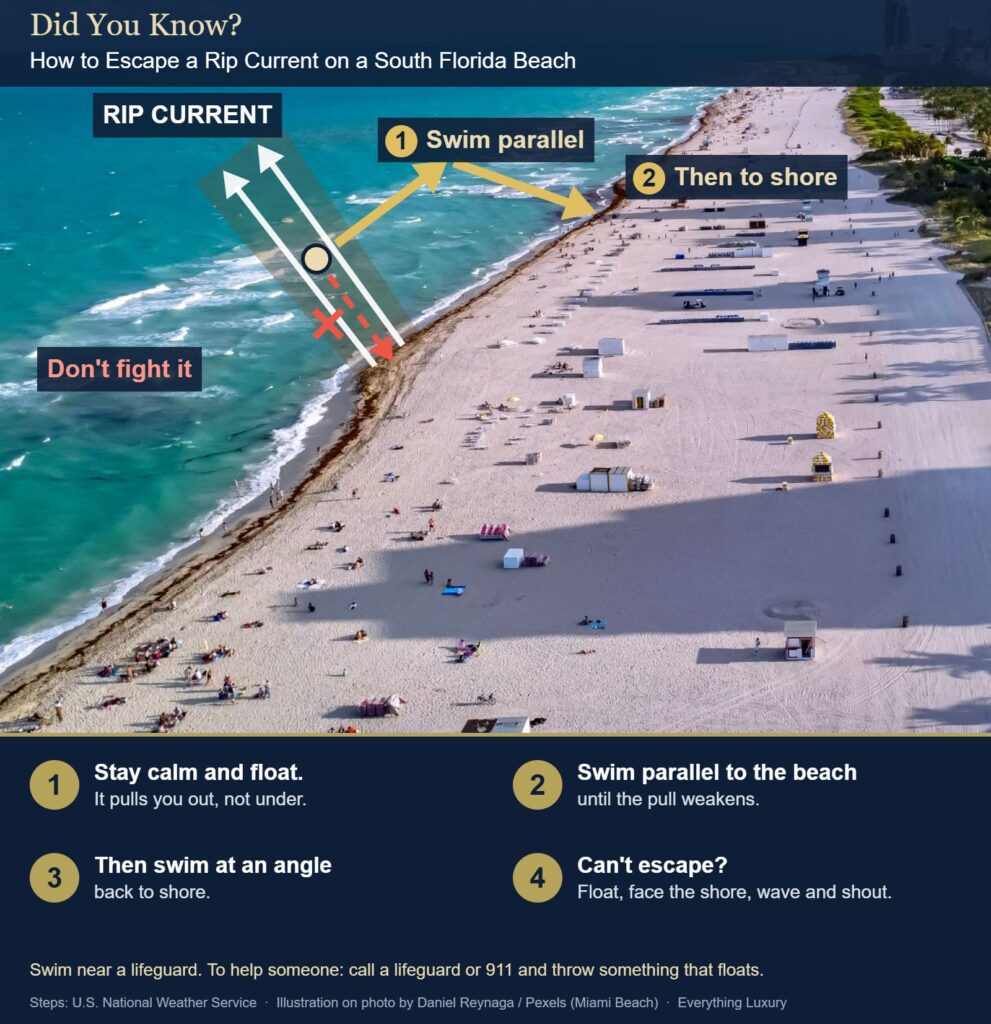
A rip current is a channel of water flowing away from shore. People often call it a “rip tide,” but it is a current, not a tide, and it pulls you out from shore, not under. The National Weather Service gives these steps:
- Stay calm and float. A rip current won’t pull you under, and floating saves your energy.
- Don’t swim straight back to shore against the current. It will wear you out.
- Swim parallel to the beach until you feel the pull weaken, then swim at an angle back to shore.
- If you can’t get out, float or tread water, face the shore, and yell or wave for help.
If someone else is caught: get a lifeguard, or call 911 if there is none. Tell the person to swim along the shoreline, and throw them something that floats. Never go in without a flotation device; the Weather Service warns that many people have died trying to rescue someone caught in a rip current.
A 2019 study of U.S. Lifesaving Association rescue data (1997–2016) found rip currents were the primary cause of 81.9 percent of lifeguard rescues on U.S. surf beaches. Swim near a lifeguard, read the beach flags, and check the National Weather Service beach forecast before you go.
Read the Beach Flags
Florida has a uniform state beach warning flag program, and public beaches that fly flags use it: green for low hazard, yellow for medium hazard, red for high hazard (high surf or strong currents), double red when the water is closed to the public, and purple for dangerous marine life. Swim near a lifeguard whenever you can.
Beach Guides by Town
Our town guides list where the lifeguards are, beach rules and local conditions lines. Start with Boca Raton, Highland Beach or Deerfield Beach.
Last updated November 14, 2026. Building details come from county property records, public listings and government sources and are deemed reliable but not guaranteed. Prices are asking prices or estimates as of the date shown. Not legal, financial or engineering advice. Full disclaimer
Sources (8) · Click to View
- National Weather Service, rip current safety, May 22, 2024 (checked November 14, 2026): source
- National Weather Service, Rip Current Safety (weather.gov/safety/ripcurrent) (checked November 14, 2026): source
- Florida Fish and Wildlife Conservation Commission, rip current safety (citing the National Weather Service) (checked November 14, 2026): source
- Brewster, Gould and Brander, “Estimations of rip current rescues and drowning in the United States,” Natural Hazards and Earth System Sciences, 2019 (USLA data, 1997–2016: 81.9% of surf beach rescues) (checked November 14, 2026): source
- National Weather Service, rip current safety, June 27, 2023 (checked November 14, 2026): source
- National Weather Service, Rip Currents (PDF) (checked November 14, 2026): source
- NOAA Ocean Today, “Rip Current Survival Guide” (video) (checked November 14, 2026): source
- Florida Senate staff analysis of CS/SB 2426 (2005), uniform beach warning flags, s. 380.276, Florida Statutes (checked November 14, 2026): source
Join the Everything Luxury Insider
One email a week, every Thursday: the best of South Florida, from new restaurants and openings to weekend events, new developments and our newest guides. Free. We never sell or share your details, and you can unsubscribe anytime.
We’ll email you once to confirm. See our privacy policy.